
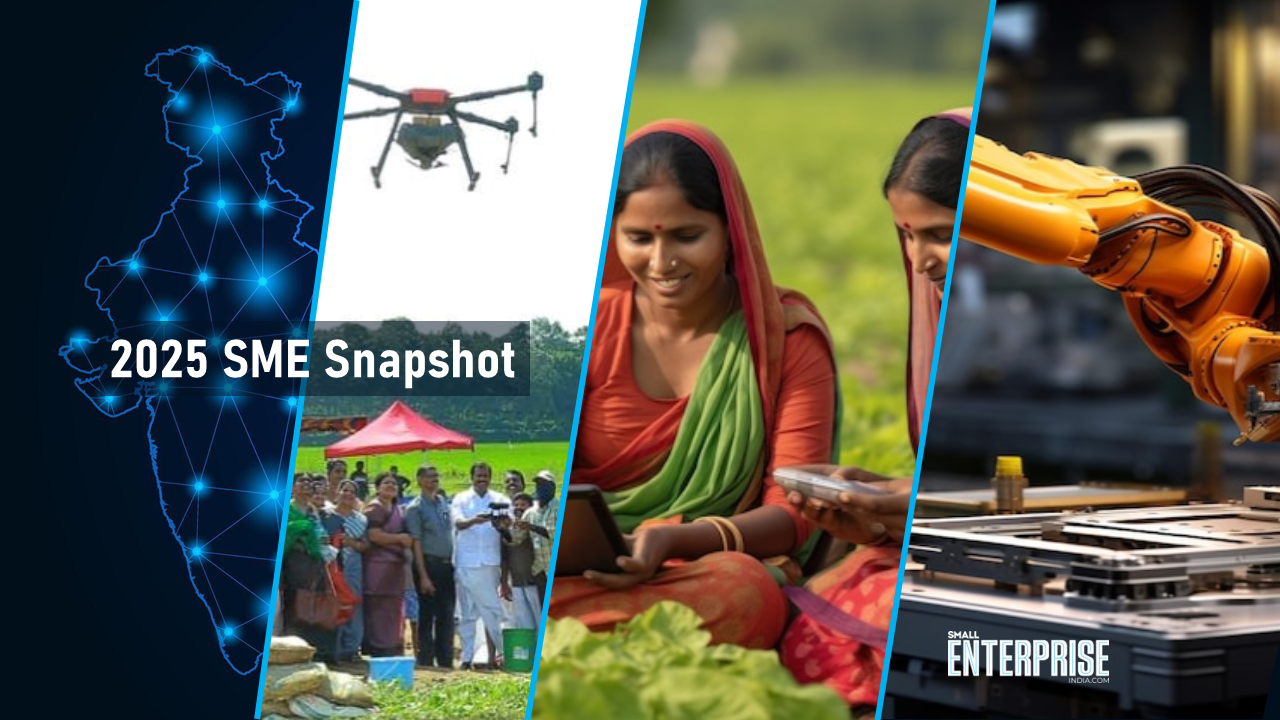
2025 marked a pivotal year for Indian SMEs, blending triumphs in digital transformation with enduring structural challenges across key sectors. Amid global uncertainties, policy interventions like GST 2.0 rate cuts and PM Gati Shakti propelled e-commerce and logistics forward, with order volumes surging 13.5% YoY and Tier-3 deliveries accelerating 29%. Total e-commerce GMV hit $151 billion, empowering rural entrepreneurs via platforms like Meesho and ONDC. Finance saw credit exposure climb 16% to ₹46 lakh crore, yet high rates and collateral gaps excluded micro-units. Exports reached $820 billion, but Red Sea disruptions hiked costs. Manufacturing digitised unevenly under Production-Linked Incentive (PLI) schemes, while revenue diversified through festive booms and UPI. Digitisation engaged 43% of SMEs, unlocking efficiencies. This year positioned SMEs for resilient growth, highlighting e-commerce’s shift to habit and the urgent need for inclusive finance and clusters. As President Trump’s pro-trade policies loom, Indian SMEs stand at a crossroads of opportunity and adaptation.
Read below how each segment performed.
Finance & Banking
Indian SMEs faced a paradoxical finance landscape in 2025, where credit growth clashed with access barriers. Total small business loans surged 16% to ₹46 lakh crore, fuelled by public-sector approvals of ₹28,000 crore and RBI’s push for priority sector lending. Fintechs offered quicker approvals via digital KYC, yet high interest rates (12-15%) and collateral demands side-lined 70% of micro-units. SME IPOs bombed, with average listing gains at 12.6%, down from prior years and over 50% trading below issue price amid market volatility. Delayed payments via platforms like SAMADHAN eased cash flow for some, but informal sectors struggled without formal credit histories.

Government schemes like Emergency Credit Line Guarantee Scheme (ECLGS) extensions helped larger SMEs scale, but tiny enterprises missed out due to compliance hurdles. RBI’s digital lending norms boosted fintech inclusion, yet NPAs hovered at 5% for MSME portfolios. Overall, while aggregate lending hit records, equitable distribution remained elusive, hampering innovation and expansion for smaller players reliant on high-cost informal loans.
Logistics
Logistics transformed for SMEs in 2025, with costs dipping toward 8-9% of GDP via PM Gati Shakti’s multimodal hubs and 15,000 km of new highways. E-commerce players scaled AI for Tier-3 speed, achieving 29% faster deliveries YoY and on-time rates jumping from 28% to 36% across 635 million orders. Micro-fulfillment centers and EV last-mile fleets cut urban delivery costs by 20% for SMEs in apparel and FMCG. Challenges included pincode errors and customer absences, which spiked issues by 4%, though route optimisation tools mitigated this.

Rural SMEs benefited from drone pilots in Kerala and Northeast, slashing transit times for perishables. Yet, fragmented carrier networks raised costs for non-metro exporters. Initiatives like ONDC integrated SMEs into unified logistics, boosting reliability. Dedicated freight corridors reduced turnaround by 30% for manufacturing hubs. The year marked logistics as a growth enabler rather than bottleneck, empowering SMEs to compete nationally.
Revenue Generation
SME revenues diversified in 2025, propelled by GST 2.0 cuts on electronics and fashion from September 22, sparking 23-25% festive surges. E-commerce order volumes rose 13.5% YoY, with Mondays leading volumes and average order values climbing 21% on prepaid trust (41% of orders). Domestic marketplaces empowered rural SMEs, while UPI-driven BNPL options extended reach to low-income buyers.
Misses: Included MSME SAMADHAN’s slow dispute resolution, delaying ₹10 lakh crore in payments. Sector-specific booms hit: textiles via PLI schemes, food processing from export quotas. Digital marketing via ONDC and Google grants amplified visibility, yet 40% of SMEs reported stagnant revenues due to input cost inflation. Festive sales normalised into habits, with AI personalisation lifting repeat orders by 15%. Subscription models in SaaS and D2C added recurring streams. Revenue resilience defined the year for adaptive SMEs navigating inflation.
Export-Import
India’s exports reached $820 billion in FY25, up 6%, opening SME doors in pharma, textiles, and auto via UK-India Comprehensive Economic and Trade Partnership Agreement (UKCEPA) tariff cuts. The India-Middle East-Europe Economic Corridor (IMEEC) streamlined marine exports, reducing Suez reliance for leather and spices SMEs. Remission of Duties and Taxes on Exported Products (RoDTEP) refunds and Export Credit Guarantee Corporation Ltd (ECGC) covers mitigated risks, aiding 20% YoY growth for labor-intensive units. Challenges: Rupee volatility and Red Sea disruptions hiked freight by 30%, squeezing margins for small importers. Geopolitics sidelined many from China shifts due to scale gaps. Government portals like Export Credit streamlined docs, yet awareness lagged in Tier-3 clusters.
Success stories: Kerala handicrafts via Amazon Global Selling hit EU markets. Duty drawback schemes reimbursed 4-7% on exports, boosting cash flow. Overall, policy tailwinds boosted participation, but logistics and compliance hurdles capped potential for fragmented SME exporters.
Manufacturing
Manufacturing SMEs grappled with promise and pitfalls in 2025, as PLI 2.0 allocated ₹1.97 lakh crore across 14 sectors. Digitisation via IoT hit 40% adoption in auto clusters, enhancing yields by 12%, but skill shortages affected 60% of units. Infrastructure like semiconductor parks in Gujarat lured investments, yet power outages and raw material imports plagued smaller players.
Misses: VC funding skewed to unicorns, leaving micro-SMEs undercapitalised. Cluster development in Coimbatore and Ludhiana improved shared tooling, cutting costs 15%. Labor reforms eased hiring, but compliance burdens rose. The year highlighted manufacturing’s pivot to green tech, with solar PLI aiding transitions. Automation pilots in Tamil Nadu factories lifted productivity 18%. Resilience through localisation defined hits for proactive SMEs amid global supply chain shifts.

Digitisation
Digitisation accelerated for 43% of SMEs in 2025, with cloud and AI budgets up 25% in IT-ITES. Udyam portal registrations topped 5 crore, unlocking GeM tenders and subsidies. IoT and ERP adoption streamlined ops in retail, boosting efficiency 18%.
Hurdles: 30% cited leadership resistance and cyber threats, especially in construction. ONDC and India Stack enabled seamless digital payments for rural units. Training via Skill India bridged gaps, with 2 million upskilled in Industry 4.0. Hits included predictive analytics slashing inventory waste. Cybersecurity frameworks like Digital Personal Data Protection Act (DPDP Act) mandated protections, reducing breaches 22%. The shift positioned SMEs for Aatmanirbhar scalability, with 70% reporting ROI within a year.
E-commerce
E-commerce matured profoundly for Indian SMEs in 2025, evolving from speculative hype to a dependable revenue engine valued at $151 billion overall, with 342 million active shoppers and 580,000 stores. Order volumes surged 13.5% YoY across 635 million tracked by ClickPost, supercharged by GST 2.0 cuts on September 22 that ignited 23-25% festive demand for electronics and fashion. Returns plummeted 7% to under 22%, thanks to precise product descriptions curbing “wrong size” and “not as described” issues, while prepaid orders normalized at 41% (up from 32%), signaling trust—especially in metros at 46%. Average order values rose 21%, as predictable deliveries encouraged bigger carts.

Tier-3 markets stole the spotlight, gaining massive momentum as AI replicated metro-grade quick commerce outward. Deliveries sped up 29% YoY—nearly 4x Tier-1 gains—with on-time rates at 36% overall, empowering rural SMEs. Prepaid adoption hit 34.5% in these areas, the fastest riser, while Mondays consistently topped volumes, turning “Monday blues” into retail therapy. Quick commerce GMV neared $6 billion, with 1,500 micro-fulfillment centers serving non-metros, where 60% of new shoppers emerged. Rural entrepreneurs in Kerala and beyond leveraged ONDC for perishables, drones, and EVs slashing last-mile costs. Wakefit’s IPO underscored operational maturity. Yet, COD reliance (59%), address typos, and customer no-shows capped perfection, up 4% in issues. Currently, as 2025 closes, Tier-3 momentum positions SMEs for 2026 dominance, with e-commerce at 8% of retail and projections to $345 billion by 2030. This “intelligence as infrastructure” era made online sales a habit, not event, for Bharat’s SMEs.
Looking Ahead to 2026
As 2025 closes, Indian SMEs stand poised for accelerated growth in 2026, building on e-commerce momentum and policy tailwinds. E-commerce GMV could double to $300 billion, with Tier-3 markets driving 40% of new orders via AI-optimised logistics and ONDC expansion, slashing rural delivery costs further. Finance inclusivity may improve as RBI’s digital lending norms mature, potentially lifting credit access to 60% of micro-SMEs through fintech-blockchain hybrids and reduced NPAs below 4%.
Logistics costs might dip under 8% of GDP with full PM Gati Shakti rollout and drone/EV ubiquity, enabling just-in-time manufacturing. Exports could surge 15% to $950 billion, fueled by IMEEC and US deals under President Trump’s administration favoring India in China shifts. PLI 3.0 and green incentives will boost manufacturing localisation to 70%, while 60% SME digitisation via UPI 3.0 and Industry 5.0 tools enhances revenues 20-25% YoY.
Challenges like climate risks and geopolitics persist, but adaptive SMEs leveraging data intelligence will thrive. 2026 heralds SMEs as India’s growth engine, targeting 10% GDP contribution through resilient, tech-led ecosystems.