



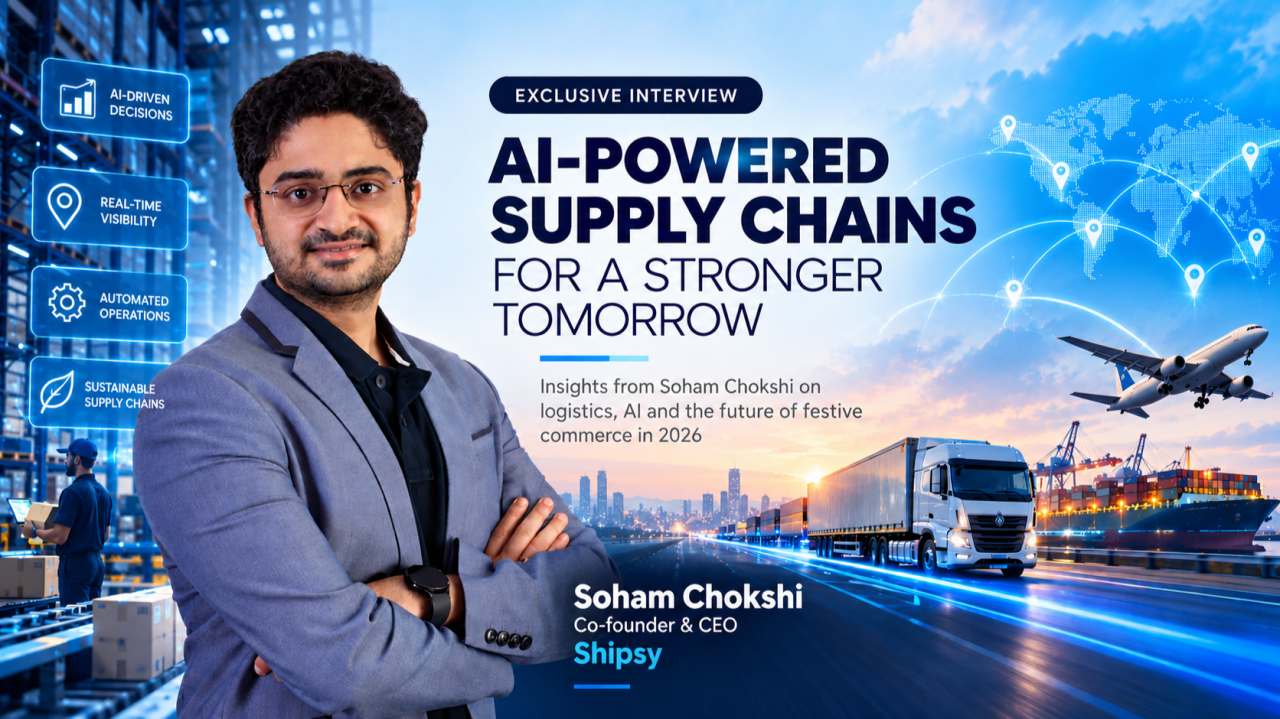
As brands and retailers gear up for the 2026 festive season, logistics is emerging as a critical differentiator in an increasingly competitive e-commerce landscape. From inventory positioning and last-mile delivery to returns management and AI-driven operations, the ability to anticipate demand and respond in real time could determine both customer satisfaction and profitability. In this exclusive industry story, Small Enterprise India speaks with Soham Chokshi, Co-Founder and CEO of Shipsy, the global logistics technology company transforming supply chains through AI, automation and intelligent orchestration. Drawing on his experience building Shipsy into a global platform, Chokshi shares his perspectives on the changing dynamics of festive commerce, the operational decisions brands must make ahead of peak demand, and why the next phase of logistics will be defined by AI agents that move beyond insights to autonomous action.
Q1. Which operational decision must brands make before festive demand begins in 2026? What data should they monitor to place inventory, reduce stockouts and control returns, and what is the financial consequence of getting that decision wrong?
Two decisions cannot be postponed, and both have to be frozen six to eight weeks out.
The first is where inventory sits. Carrier capacity, warehouse space, even ad budgets can be bought late. Inventory position cannot. Once demand starts, moving stock between nodes costs more than the margin on the goods being moved.
Most brands still make this call off state-level or trailing-twelve-month numbers, and that is where it breaks. You need SKU-level demand at a pincode-cluster grain from the last two festive cycles, node-level fill rates instead of aggregate stock cover, and promise-versus-actual transit times modelled at peak volume rather than today’s. On returns, the signals sit before the shipment even leaves: RTO history by pincode and payment mode, COD share by cluster, and address quality at order capture. Across the shipments we process, a significant share of RTO traces back to addresses that were never deliverable in the first place, and nearly all of it was visible at the moment the order was placed.
The second decision is manpower, and it is the one that has changed this year. Festive hiring is usually reactive. Brands scale headcount in September, then spend the peak training people who leave in December. The better exercise is to map which parts of your operation are genuinely manpower-heavy, then separate the work that needs judgment from the work that is only volume. Carrier allocation, exception triage, WISMO queries, address correction, rescheduling, first-level escalation. These are decision loops agents can now run end to end at peak volume without a hiring cycle. What stays human is the smaller set of calls that carry real cost, like high-value exceptions and key account escalations.
Getting either call wrong is expensive in an asymmetric way. A stockout in a normal week is a lost sale. In the festive window it is a lost customer. Overstock the wrong node and you pay twice, once on the lost sale and again on the post-festive markdown.
Q2. Which festive tactic worked in previous years but is likely to underperform in 2026, and what should companies do instead?
The tactic losing its edge, in our part of the chain, is scaling the season with bodies and a single logistics setup: more temporary hires, one primary carrier, a few big warehouses shipping long-distance. It worked when festive was a predictable October-November bump. The catch is that the most valuable thing in a logistics operation is not the trucks or the extra hands but the operational knowledge in your dispatchers’ and drivers’ heads, and a workforce hired in October does not have it yet.
Festive hiring is up 15-20%, but that manpower takes weeks to become useful, exactly when there are no weeks to spare. What scales instead is orchestration. Multi-carrier allocation flexes delivery capacity a brand does not own; warehouse throughput lifts units picked per hour rather than just adding pickers; and automation lets a smaller, experienced team supervise the exceptions instead of running every call. One European parcel carrier we work with moved from one dispatcher for every 40 drivers to one for every 80 and lifted productivity by about 20%, without adding people in step with volume.
The thing that actually caps festive volume is rarely the storefront. It is whether the warehouse can pick, pack and dispatch, and whether the carrier network can absorb the spike.
Q3. In your opinion, what has changed most in 2026 festive planning compared with last year, and what are the key signals which have prompted that change?
The biggest change is that festive is now won in execution speed, not in the seasonal plan. A year ago most brands allocated a fixed quantity to a region and expected the October-November uplift to even out. Two things ended that. Quick commerce means non-grocery demand is now growing roughly 1.6x faster than grocery and landing in hours at a specific dark store, not over weeks across a circle. And the operation underneath turned more technical, which is where the real shift sits for us: an insight on a screen never becomes an action on its own. A delay model can flag 200 shipments at risk of missing their promise, but the value only shows up when something acts on it: reroutes the 30 most urgent, sends a fresh delivery window to another 150, holds back the 20 it is not sure about for a person, and writes all of it into the system.
That is what festive forces this year, the move from dashboards that report to systems that act, with people stepping in on the exceptions. Planning turned technical this year because the operation underneath it turned technical first.
Q4. If you had to identify one rule that will define the 2026 festive playbook across brands, marketplaces and retailers, what would it be? Which companies/categories are best positioned to benefit from it, and which are most exposed?
One rule: in 2026 the festive result is set by the logistics operation, not the offer. Brands, marketplaces and retailers have long competed on assortment, price and the storefront, and those still matter, but this year the deciding variable is whether the operation can deliver what the offer promised at speed and absorb what comes back. Logistics stops being the cost line you try to minimise and becomes the lever you win on.
The players positioned to benefit are the ones that run fulfilment, delivery and returns as one instrumented operation they can see and act on in real time, whether that is a quick-commerce platform, a marketplace or a D2C brand that has built it. The exposed are the ones that still treat logistics as an outsourced afterthought with little visibility into it, heavy or slow-moving categories such as large appliances and furniture that cannot flex to a festive rhythm, and any brand whose delivery and returns network was sized for a normal week rather than a festival week. It shows up in numbers that look small until you scale them: one network we work with lifted its promised-delivery-slot adherence from 59% to 87% purely by making the operation act in real time, and at festival volume that gap is the difference between a kept order and a refund.
Q5. What is the strongest counterargument to the industry’s expectations for the 2026 festive season? Where could brands be overestimating demand, underestimating costs or misreading consumer behaviour?
Whether part of the festive GMV is demand pulled forward from adjacent months is the brands’ call to read. What I can speak to is the cost side, and there the strongest counterargument is that brands underestimate the cost tail of speed. Dark stores, denser delivery and temporary hiring all persist into January after volumes normalise, so a season run hotter than the operation was built for leaves that cost on the books well after the festival.
The most underestimated piece is returns, and it is a logistics cost, not a marketing one. Festive drives the biggest reverse-logistics spike of the year, and in a cash-on-delivery-heavy market that is a wave of RTOs that either get processed fast and resold while the season is still on, or clog the network and turn into write-downs. This is where festive margin quietly leaks, and it is the least-planned part of most brands’ readiness. In one Indian quick-commerce grocery operation we work with, rescuing failed deliveries at the doorstep, rather than sending them back, recovered about a quarter of would-be returns in a pilot and cut driver wait at the hub from roughly 30 minutes to under five. Most brands plan the sale in detail and the return flow barely at all.
Q6. What role will AI play across marketplaces and quick commerce platforms this festive season that is different from previous years? How are companies preparing for it?
The change is that AI moves from the shop window to the operating core. For the last few seasons, AI on these platforms mostly lived in search, recommendations and chat, shaping what a shopper saw. This year it is being handed operational decisions: which shipment to reroute the moment a delay shows, which orders to batch into a single run, and which carrier to move volume to when one starts slipping. Gartner expects task-specific AI agents in around 40% of enterprise applications by the end of 2026, up from under 5% in 2025, and logistics is one of the clearest places it is happening, because the decisions are high-frequency and measurable.
What it changes on the ground is the shape of the job: every operations role becomes a supervisory one, where the machine takes the repetitive volume and the person keeps the judgment calls and the exceptions. Across the networks we run, close to 94% of these routine operational decisions now resolve without a person touching them.
The preparation that matters is unglamorous: putting warehouse, last-mile and returns on one view, so that when the system flags an exception, a person can act on it the moment it happens rather than after a customer has felt it.